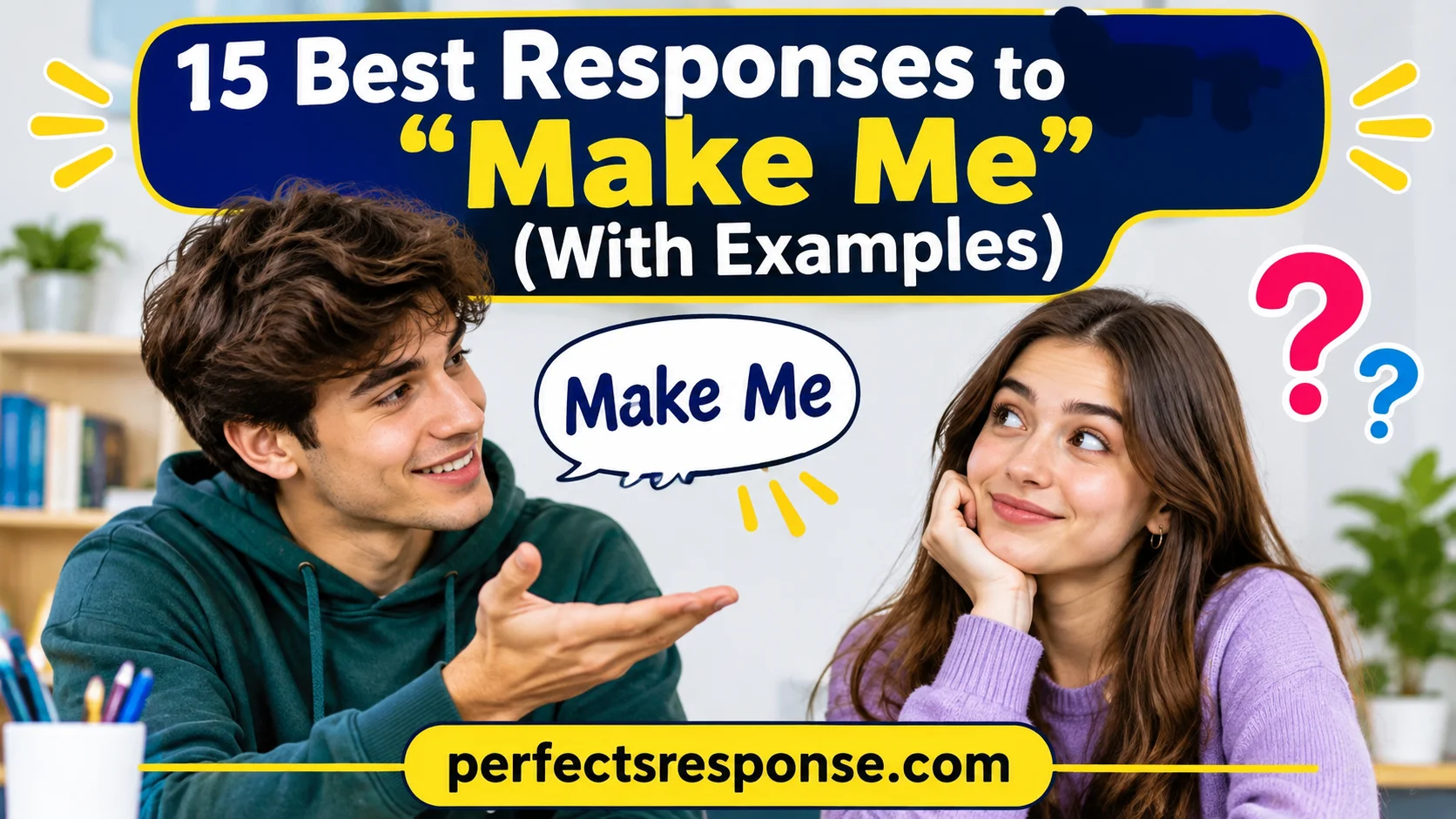
Finding the Best Responses to “Make Me” (With Examples) can help you answer confidently when someone uses this challenging phrase. Depending on the situation, “make me” may sound playful, teasing, sarcastic, or confrontational. Instead of reacting angrily, choose words that match your mood and relationship with the speaker. A clever comeback can keep things light, while a calm, firm reply can prevent a small disagreement from turning into an unnecessary argument and help you stay in control.
The key is knowing when to joke, flirt, respond with confidence, or set a clear boundary. You might be talking with a friend, partner, crush, or someone who is testing your patience. This collection brings together funny, witty, sarcastic, flirty, playful, and savage replies for different moments. Each response gives you a natural way to keep the conversation moving without sounding rude or losing your cool. Choose the one that feels genuine and fits the message and tone.
1. Don’t Tempt Me!
Imagine you’re chatting with someone who enjoys teasing you. You ask them to do something, and they respond with “Make me.” Instead of getting annoyed, you decide to play along by saying, “Don’t tempt me!” This response adds a little mystery and humor to the conversation. It works particularly well when there’s mutual attraction or a playful friendship. Your words suggest that you’re confident enough to accept their challenge, but you’re not taking the conversation too seriously. The beauty of this comeback is that it leaves room for the other person to continue joking. It can turn an ordinary exchange into a fun, memorable interaction without sounding aggressive or demanding.
Meaning
“Don’t tempt me!” means the other person’s challenge is tempting you to respond or take playful action.
Tone
Playful, flirty, confident, and teasing. It communicates interest without making the conversation overly serious.
Best Use
- Flirty conversations with someone you like.
- Playful exchanges with close friends.
- Lighthearted teasing with someone who understands your humor.
When to Use This Response
Use this reply when you want to accept someone’s playful challenge without committing to anything. It is especially effective when both people are comfortable with flirtatious humor.
More Example Replies
- “Careful, I might actually take you up on that!”
- “You have no idea what you’re asking for.”
- “Don’t challenge me unless you mean it!”
Similar Responses
- You’re asking for trouble! – A humorous warning.
- Careful what you wish for! – A playful challenge.
- I might just do that! – A confident, teasing reply.
2. Challenge Accepted!
Sometimes, the best response to “Make me” is to show that you’re not intimidated. Saying “Challenge accepted!” turns the other person’s stubbornness into an opportunity for friendly competition. Imagine your friend refuses to join you for a workout, finish a game, or try a new activity. Instead of arguing, you respond with a smile and say, “Challenge accepted!” The phrase makes the conversation more entertaining because it shows you’re willing to play along. It also communicates confidence without requiring an aggressive attitude. Whether you’re talking to a sibling, friend, or romantic interest, this comeback works when the exchange is lighthearted and both people enjoy a little friendly competition.
Meaning
“Challenge accepted!” means you’re willing to take on the challenge someone has presented.
Tone
Confident, enthusiastic, competitive, and playful. It shows determination and a willingness to participate.
Best Use
- Friendly competitions.
- Playful arguments between friends.
- Flirty challenges.
- Casual conversations involving jokes or dares.
When to Use This Response
Choose this reply when someone says “Make me” as a joke and you want to turn their resistance into a fun challenge. Avoid using it when the other person is genuinely upset.
More Example Replies
- “Oh, it’s on!”
- “I never back down from a good challenge.”
- “Let’s see who wins this one!”
Similar Responses
- Game on! – Short and energetic.
- I’m up for it! – Friendly and enthusiastic.
- Bring it on! – Bold and competitive.
3. You Don’t Want to Test Me!
If someone keeps challenging you or refusing to take your requests seriously, “You don’t want to test me!” can communicate that you’re not interested in endless arguments. For example, imagine a friend repeatedly ignores a reasonable request and responds with “Make me.” You could use this phrase to show that their attitude is becoming frustrating. However, context matters because the expression can sound intimidating if delivered angrily. In a playful conversation, it may come across as confident teasing. In a serious disagreement, it communicates a stronger boundary. Your facial expression and delivery help determine whether the other person hears it as a joke or a warning.
Meaning
It means the other person should not keep pushing your patience or challenging your limits.
Tone
Assertive, serious, confident, and sometimes intimidating. Its effect depends heavily on delivery.
Best Use
- Setting boundaries with someone being disrespectful.
- Responding to repeated teasing.
- Communicating frustration without starting a lengthy argument.
When to Use This Response
Use this phrase when someone repeatedly tests your patience and you want them to recognize that you’re serious. In sensitive situations, a calmer boundary-setting statement may be more effective.
More Example Replies
- “I’m really not in the mood for this today.”
- “Let’s not turn this into an argument.”
- “You know I don’t appreciate that attitude.”
Similar Responses
- Don’t push your luck! – A warning against going too far.
- Know your limits! – A direct boundary.
- Let’s keep things respectful. – A calmer alternative.
4. I Thought You’d Never Ask!
When someone says “Make me” in a flirty or teasing conversation, responding with “I thought you’d never ask!” can be a clever way to keep the energy going. Imagine your crush jokingly challenges you to convince them to go on a date or try something new. Instead of giving a serious explanation, you reply with this playful expression. It suggests that you’ve been waiting for an opportunity to respond. The phrase is especially useful because it communicates confidence while leaving the other person curious about what you’ll say next. It can make a conversation feel spontaneous and entertaining, provided the other person is comfortable with the playful exchange.
Meaning
It means you were expecting or hoping the other person would give you an opportunity to take action.
Tone
Flirty, humorous, confident, and enthusiastic.
Best Use
- Romantic conversations.
- Playful texting.
- Friendly teasing between people who know each other well.
When to Use This Response
Choose this response when “Make me” is clearly meant as a playful invitation rather than a serious refusal. It helps maintain flirtation without making the interaction uncomfortable.
More Example Replies
- “Finally, permission to show you what I can do!”
- “I’ve been waiting for this moment.”
- “Well, now we’re getting somewhere!”
Similar Responses
- Say no more! – Shows immediate enthusiasm.
- Your wish is my command! – Playfully suggests cooperation.
- About time you asked! – Adds humorous confidence.
5. You Know I Can!
Sometimes, a short and confident answer is more effective than a long comeback. “You know I can!” works particularly well when someone challenges you because they already know you’re capable of doing what they asked. Imagine a close friend telling you to prove that you can convince them to participate in an activity. You smile and respond, “You know I can!” The statement communicates self-assurance without requiring you to explain yourself. It can also work in romantic conversations where two people enjoy teasing each other. However, confidence should never become pressure. The goal is to keep the exchange enjoyable while respecting the other person’s choices.
Meaning
“You know I can!” means you’re confident in your ability to handle the challenge.
Tone
Self-assured, playful, bold, and sometimes flirty.
Best Use
- Conversations with close friends.
- Friendly competitions.
- Flirty exchanges.
- Situations where the other person already knows your personality.
When to Use This Response
Use it when you want to communicate confidence and remind someone that you can handle a playful challenge. It works best when you have an established, comfortable relationship.
More Example Replies
- “You should know better than to challenge me.”
- “I’ve got this, trust me.”
- “You haven’t seen anything yet!”
Similar Responses
- I know what I’m capable of! – More serious confidence.
- Watch me! – Short and bold.
- I can handle it! – Direct and reassuring.
6. Why Would I? You’re Already Convinced!
Not every “Make me” deserves a serious comeback. Sometimes, a clever sarcastic response can end the exchange while making everyone laugh. Saying “Why would I? You’re already convinced!” suggests that the other person has made up their mind, so there’s no reason to waste energy persuading them. Imagine a friend stubbornly refusing to admit that your favorite restaurant serves better food. Instead of continuing the debate, you deliver this humorous reply. It works because you’re turning their stubborn attitude into the joke. The phrase is especially useful when you want to sound witty without becoming openly rude. Just make sure your relationship allows for sarcasm.
Meaning
It means you don’t see a reason to persuade someone who has already decided what they believe.
Tone
Sarcastic, witty, humorous, and slightly dismissive.
Best Use
- Friendly arguments.
- Conversations with sarcastic friends.
- Lighthearted disagreements.
- Situations where both people enjoy clever humor.
When to Use This Response
Use it when someone is being stubborn in a harmless discussion and you want to respond with humor instead of continuing the argument.
More Example Replies
- “I didn’t realize convincing you was part of my job.”
- “You’ve already made up your mind, haven’t you?”
- “I’ll save my energy for something more productive.”
Similar Responses
- Whatever you say! – A dismissive but casual response.
- Suit yourself! – Suggests the other person can decide.
- I’m not wasting my breath! – More openly sarcastic.
7. Only If You Ask Nicely!
A little politeness can make a playful argument much more entertaining. When someone says “Make me,” replying with “Only if you ask nicely!” turns their challenge into a humorous request for good manners. Imagine your younger sibling refusing to help you with something simple. Rather than getting annoyed, you jokingly tell them that they need to ask nicely first. The phrase can also work in flirty conversations, especially when both people enjoy playful teasing. It communicates that you’re willing to cooperate, but you expect a little courtesy. The response is lighthearted, memorable, and easy to adapt to different situations without sounding overly demanding.
Meaning
It means you’re willing to help or cooperate if the other person approaches you politely.
Tone
Playful, friendly, cheeky, and lightly assertive.
Best Use
- Conversations with siblings.
- Friendly teasing.
- Flirty exchanges.
- Casual situations where someone is being stubborn.
When to Use This Response
Choose this response when you want to encourage someone to change their attitude without making a big deal out of the situation. It is particularly effective when the original challenge is meant jokingly.
More Example Replies
- “A please would go a long way!”
- “Try asking with a little kindness.”
- “Good manners might get you somewhere!”
Similar Responses
- Ask nicely, and we’ll see! – Friendly and teasing.
- Where are your manners? – A humorous reminder.
- A little please never hurts! – Polite and lighthearted.
Read More: 15 Best Responses to “My Apologies” (With Examples)
8. I’d Rather Not Waste My Time!
Sometimes, “Make me” isn’t playful at all. It can be a sign that someone is deliberately being difficult or disrespectful. In that situation, responding with “I’d rather not waste my time!” communicates that you’re unwilling to continue an unproductive argument. Imagine asking a coworker to complete a simple task, only to receive an unnecessarily challenging response. Rather than getting drawn into a disagreement, you calmly explain that you won’t waste time arguing. This response is useful because it shifts the focus away from winning the conversation and toward protecting your time and energy. It sounds direct, so use it when you genuinely want to end the discussion.
Meaning
It means you don’t want to spend additional time arguing with someone who isn’t willing to cooperate.
Tone
Firm, serious, dismissive, and self-respecting.
Best Use
- Unproductive disagreements.
- Conversations involving disrespect.
- Situations where someone repeatedly refuses reasonable requests.
- Professional interactions that require clear boundaries.
When to Use This Response
Use it when the conversation is going nowhere and you want to disengage rather than continue exchanging sarcastic remarks. In professional situations, consider a more diplomatic version.
More Example Replies
- “I’m not interested in arguing about this.”
- “Let’s focus on something more productive.”
- “I think we’re done discussing this.”
Similar Responses
- It’s not worth the argument. – Calmly ends the disagreement.
- Let’s move on. – Neutral and professional.
- I have better things to do. – More blunt and dismissive.
9. Watch Me!
If someone challenges your ability to do something, “Watch me!” is a short, powerful comeback. It communicates that you don’t need to argue or explain yourself because you’re confident you can demonstrate your abilities. Imagine your friend saying you can’t finish a difficult puzzle or learn a new skill. Instead of defending yourself, you simply reply, “Watch me!” This phrase turns doubt into motivation and gives the conversation an energetic feeling. It can also work in playful romantic exchanges when someone jokingly questions your confidence. The key is to use it with a smile when the situation is lighthearted and with genuine determination when you’re responding to a real challenge.
Meaning
“Watch me!” means you’re going to demonstrate that you can do something despite someone’s doubts.
Tone
Bold, confident, determined, and sometimes playful.
Best Use
- Friendly challenges.
- Competitive conversations.
- Motivational exchanges.
- Playful arguments with friends or partners.
When to Use This Response
Use this reply when you want your actions to speak louder than your words. It is especially suitable when someone doubts your ability or tries to discourage you.
More Example Replies
- “Just give me a minute.”
- “I’ll prove you wrong.”
- “You might be surprised!”
Similar Responses
- Just wait and see! – Builds anticipation.
- I’ll show you! – Direct and confident.
- Consider it done! – Emphasizes determination.
10. That’s Not How Respect Works!
When someone uses “Make me” in a disrespectful way, responding with humor may not solve the problem. Sometimes, you need a statement that makes your expectations clear. “That’s not how respect works!” communicates that you expect people to treat you with basic courtesy. Imagine asking someone to stop making inappropriate jokes, only for them to challenge you instead of listening. You can use this response to explain that mutual respect matters more than winning an argument. It is particularly useful in situations where someone repeatedly dismisses your feelings or boundaries. Rather than threatening or insulting them, you’re making it clear that respectful communication is important.
Meaning
It means that respect should be mutual and that challenging or dismissing someone isn’t an appropriate way to communicate.
Tone
Serious, assertive, mature, and respectful.
Best Use
- Setting personal boundaries.
- Addressing disrespectful behavior.
- Family or friendship disagreements.
- Professional conversations involving inappropriate attitudes.
When to Use This Response
Choose this phrase when someone is being deliberately disrespectful and you want to address their behavior directly. It works best when delivered calmly rather than angrily.
More Example Replies
- “You can disagree without being disrespectful.”
- “Let’s speak to each other properly.”
- “I expect the same respect I give you.”
Similar Responses
- Please speak respectfully. – Polite but firm.
- That’s unacceptable behavior. – More formal and serious.
- Let’s keep this civil. – Encourages respectful discussion.
11. Maybe You Should Try Asking Instead!
A playful way to respond to “Make me” is to suggest that the other person change their approach. “Maybe you should try asking instead!” is a clever comeback that encourages better communication without creating unnecessary tension. Imagine a friend demanding that you share your notes or help them with an assignment. When they jokingly refuse to cooperate, you respond by suggesting that they ask nicely. The phrase works because it makes your point while keeping the interaction friendly. It also reminds people that cooperation is easier when requests are respectful. Whether you’re talking to friends, siblings, or someone you’re dating, this response can turn a stubborn moment into an opportunity for a laugh.
Meaning
It means the other person should make a polite request instead of issuing a challenge or acting demanding.
Tone
Friendly, witty, encouraging, and mildly sarcastic.
Best Use
- Casual conversations.
- Playful disagreements.
- Family interactions.
- Situations involving unnecessary demands.
When to Use This Response
Use this phrase when you want someone to communicate more politely. It is particularly useful when their refusal seems more about attitude than the actual request.
More Example Replies
- “A simple request would work better.”
- “Have you considered using the word please?”
- “Try being nice. It might actually work!”
Similar Responses
- Could you ask a little more nicely? – Polite and direct.
- Manners matter! – Short and humorous.
- Just say please! – Casual and straightforward.
12. I Don’t Have to Prove Anything to You!
There are times when someone challenges you simply because they want a reaction. In those moments, “I don’t have to prove anything to you!” can be an effective way to protect your confidence. Imagine someone questioning your abilities or repeatedly demanding that you demonstrate something you’ve already accomplished. Instead of getting caught up in their expectations, you remind them that your worth doesn’t depend on their approval. This response is especially useful when dealing with unnecessary criticism or competitive behavior. It establishes emotional independence and helps you avoid wasting energy on pointless arguments. However, it may sound defensive if used during a friendly conversation, so consider the other person’s intentions first.
Meaning
It means you don’t feel obligated to demonstrate your abilities or justify yourself to someone.
Tone
Confident, firm, independent, and sometimes defensive.
Best Use
- Responding to unnecessary criticism.
- Dealing with people who constantly challenge you.
- Protecting your personal boundaries.
- Ending arguments about your abilities.
When to Use This Response
Choose this reply when someone is trying to make you feel that you must earn their approval. It communicates self-respect and reminds them that you don’t need to engage in every challenge.
More Example Replies
- “I know what I bring to the table.”
- “My actions speak for themselves.”
- “Your approval isn’t necessary.”
Similar Responses
- I know my worth. – Emphasizes self-confidence.
- I have nothing to prove. – Direct and self-assured.
- Believe what you want. – Ends an unnecessary debate.
13. Is That a Challenge or an Invitation?
If you’re looking for a clever and slightly flirty response to “Make me,” this phrase can be an excellent choice. It works by turning an ambiguous statement into a playful question. Imagine someone you’re interested in teasing you during a conversation. Instead of taking their words literally, you respond, “Is that a challenge or an invitation?” The question creates an opportunity for them to explain their intentions while keeping the conversation entertaining. It can be particularly effective in text messages because it invites a response and keeps the exchange going. However, use it only when there’s mutual comfort and the other person appears interested in playful conversation.
Meaning
It means you’re asking whether the other person’s challenge is serious or an invitation to continue flirting or joking.
Tone
Flirty, curious, witty, and teasing.
Best Use
- Romantic conversations.
- Flirty text messages.
- Playful exchanges with someone you know well.
- Situations involving mutual teasing.
When to Use This Response
Use this phrase when someone says “Make me” with a playful or flirtatious attitude. It helps you discover whether they’re joking, challenging you, or encouraging further conversation.
More Example Replies
- “Should I take that as a dare?”
- “Are you testing me right now?”
- “Is this your way of asking for attention?”
Similar Responses
- Are you challenging me? – More competitive.
- Should I take that seriously? – Curious and playful.
- Are you flirting with me? – More direct and romantic.
14. You Can Do It Yourself!
Sometimes, the best comeback is a straightforward reminder that the other person is responsible for their own choices. “You can do it yourself!” works when someone tries to turn a simple request into an unnecessary argument. Imagine a friend asking you to complete a task for them, then responding with “Make me” when you ask them to handle something independently. You can calmly remind them that they are perfectly capable of doing it themselves. This phrase communicates independence and discourages unnecessary dependence. Although it can sound blunt, it is useful when you want to establish that you’re not obligated to do everything for someone else.
Meaning
It means the other person is capable of completing the task without expecting you to do it for them.
Tone
Direct, independent, assertive, and sometimes sarcastic.
Best Use
- Conversations with friends or siblings.
- Situations involving unreasonable requests.
- Encouraging personal responsibility.
- Setting boundaries around your time and effort.
When to Use This Response
Use it when someone expects you to handle something they can reasonably do themselves. If you want to maintain a friendly relationship, deliver it politely rather than sounding irritated.
More Example Replies
- “I think you’ve got this on your own.”
- “Why not give it a try yourself?”
- “You’re more than capable of handling that.”
Similar Responses
- Handle it yourself. – More direct.
- You’ve got this! – Encouraging and supportive.
- Take some initiative. – Emphasizes responsibility.
15. Let’s Not Make This a Big Deal!
Not every disagreement needs to become an argument. When someone says “Make me” during a minor disagreement, responding with “Let’s not make this a big deal!” can help both people step back and reconsider the situation. Imagine your friend refuses to help you with something small and starts turning the conversation into a competition. Instead of matching their attitude, you suggest keeping things simple. This response is useful because it prioritizes the relationship over winning a pointless argument. It communicates that you’re not interested in unnecessary drama and would rather resolve the situation peacefully. It works especially well when both people are willing to move forward.
Meaning
It means you don’t want a small disagreement or misunderstanding to develop into a larger conflict.
Tone
Calm, mature, friendly, and reassuring.
Best Use
- Minor disagreements.
- Conversations with friends or family.
- Resolving misunderstandings.
- Situations where maintaining a relationship matters more than winning an argument.
When to Use This Response
Choose this reply when someone is becoming unnecessarily argumentative over something unimportant. It helps redirect the conversation toward understanding and cooperation.
More Example Replies
- “It’s really not worth arguing about.”
- “Let’s just sort this out calmly.”
- “We can disagree without making things awkward.”
Similar Responses
- Let’s keep it simple. – Practical and relaxed.
- No need to argue. – Direct and peaceful.
- Let’s move past this. – Encourages resolution.
FAQs:
1. What is the best response to “Make me”?
The best response depends on the situation and your relationship with the person. You can say, “I don’t need to, you already know what to do,” or “Challenge accepted!” These replies sound confident, playful, and natural.
2. How do you respond to “Make me” in a funny way?
You can use a humorous comeback to keep the conversation light. Try saying, “Do I look like a remote control?”, “Nice try, but I’m off duty,” or “That’s not in my job description!” These responses can make the other person laugh.
3. What should I say when someone says “Make me” sarcastically?
When someone uses a sarcastic tone, respond with confidence instead of getting upset. You could say, “I don’t have to prove anything to you,” or “You can make your own decisions.” A calm response shows that you aren’t interested in unnecessary arguments.
4. How do you respond to “Make me” when flirting?
If someone says “Make me” in a flirty or teasing way, you can respond with something playful and charming. Try “Careful, I might take that as a challenge,” or “Only if you ask nicely.” Choose a reply that matches your comfort level and the mood of the conversation.
5. How do you respond to “Make me” without being rude?
Keep your response polite, confident, and straightforward. You can say, “It’s your choice,” “I’m not going to force you,” or “You can decide for yourself.” These replies help you express your point without creating unnecessary tension.
Conclusion:
Knowing the best responses to “Make Me” can help you handle different conversations with confidence and ease. Whether someone is teasing you, flirting, being sarcastic, or trying to challenge your patience, the right comeback can make a difference. You can choose a funny, witty, flirty, savage, or respectful reply depending on the situation. Remember, you don’t always need a clever comeback to win a conversation. Sometimes, staying calm, setting boundaries, and choosing your words wisely is the strongest response. Use the examples in this guide to express yourself naturally and keep every conversation under control.

Adam West is an English-language writer with a passion for storytelling, culture, and everyday life. His writing focuses on clear ideas, engaging narratives, and thoughtful perspectives that are easy for readers to connect with.






1 thought on “15 Best Responses to “Make Me” (With Examples) ”